B2B Manufacturer Website Design That Wins RFQs
B2B manufacturer website design is the planning and building of a website for a company that sells to other businesses: capabilities, product and service lines, specifications, certifications, industries served and a request for quote path. It is for manufacturers and B2B firms with long, technical sales. Brand Overture builds these sites on WordPress from Phoenix.
Your buyer is an engineer with a spec sheet and no patience
The person on your website is not browsing. She is an engineer, a buyer or a procurement lead with a requirement and a shortlist. She needs to know in a minute whether you make what she needs, to the standard she needs, in the region she needs it. If the capabilities page is a paragraph of adjectives, the spec sheet is missing and the contact form asks for a message with no fields for what she actually wants, she moves to the next vendor.
B2B sales cycles are long, but the website decision is short. Most manufacturer websites were built to look like a brochure and never considered the person doing the specifying.
How we build a manufacturer website
We start with how your buyers navigate: by service, by industry, by product line, by region. That becomes the site architecture, so a buyer reaches their page in one click instead of hunting through a menu built around your departments.
Capabilities and product pages carry the specs, certifications, tolerances and downloads an engineer needs to qualify you. Case studies and credentials sit where procurement looks for them. The request for quote path captures the fields sales needs to respond quickly, and routes to the right person by product or region.
The site is built on WordPress so marketing can add a product line, a resource or a news item without a developer. Technical SEO is done from the start so Google can index a deep catalog and the terms your buyers search.
The site qualifies the lead before sales picks up the phone
Quote requests arrive with the product, the quantity and the region already stated. Sales spends less time on first calls that go nowhere. Engineers find the spec they need and move you onto the shortlist without emailing anyone.
Distributors and partners send prospects to a site that makes you look like the company they described. And because every capability page is written to be found, the site keeps working between trade shows.
Terrence handles the project from the first call to launch. Book the call and bring your current site. We will tell you where it is losing RFQs.
How your next customer finds a manufacturers & b2b business.
Four moments. The website has to win every one of them.
- Moment 01
They search
On Google, on Maps, or by asking an AI assistant. The question is specific and local.
- Moment 02
They find you
In the Map Pack, the organic results or the AI answer. Or they find a competitor.
- Moment 03
They check you out
The page loads fast on a phone, answers their question and shows real proof.
- Moment 04
They act
A call, a quote request or a booking, with as few steps as possible.
What's included
Everything in scope. Nothing vague.
Your written scope lists each item, so you know what you are paying for before work starts.
- Capabilities and service pages organized the way your buyers think, not your org chart
- Product or service line pages with specs, downloads and certifications
- Industries served and regions served navigation for multi-market companies
- Request for quote path that captures what sales needs to respond
- Case studies and credentials placed where procurement looks
- Technical and on-page SEO for the terms engineers and buyers search
- Training so marketing can add products, news and resources
From first call to takeoff.
One person, Terrence, runs every step. Here is the sequence.
-
Free call
Thirty minutes on what you make, who specifies it and how a quote request moves through sales today. You leave with a plan either way.
-
Fixed scope
A written scope and price. Nothing starts until you approve it.
-
Architecture
Site map and navigation designed around services, industries and regions, so a buyer finds their path in one click.
-
Design and build
Templates for capabilities, products and case studies, built on WordPress and loaded with your content. Tested on desktop and phone.
-
Launch and train
We launch, confirm quote requests route to the right people and train marketing on the admin.
Proof from real work.
Real clients, real builds. No invented numbers.
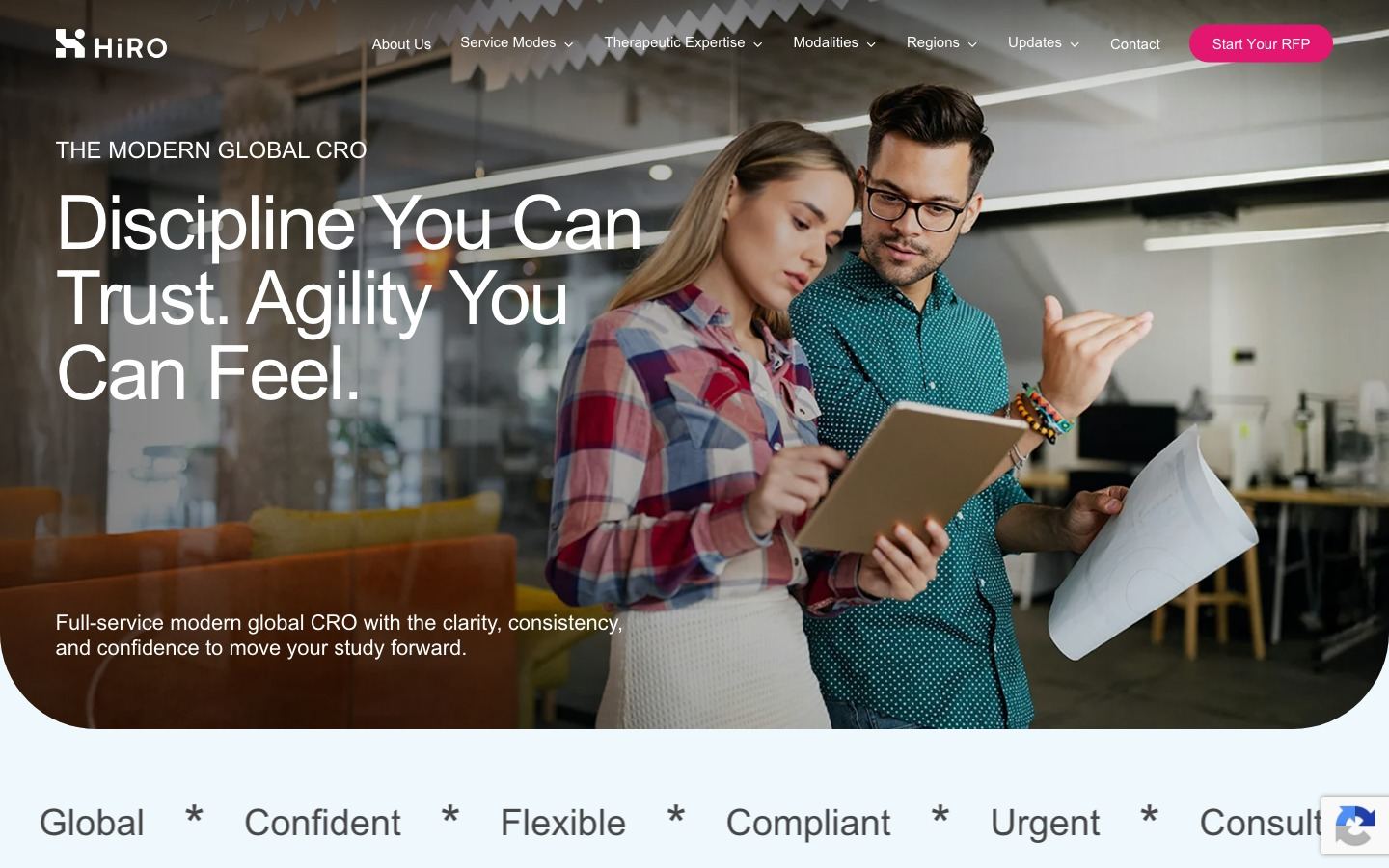

Hiro
Hiro is a global clinical research organization. Its site had to win the trust of sponsors comparing partners across continents, with navigation by service, by therapeutic area and by region so a buyer could reach the right page in one click. We built it on WordPress with a structure the team can extend as services and locations grow.
Pricing. No dollar figures on a web page can be honest without knowing your scope. After a free 30-minute call you get a fixed scope and price in writing before any work starts.

Questions about manufacturers & b2b.
How much does a B2B manufacturer website cost?
It depends on how many product or service lines you have, how much technical content needs structuring and whether SEO is included. After a free 30-minute call you get a fixed scope and price in writing before any work starts.
How long does it take?
Most B2B sites launch in eight to fourteen weeks. Technical content, spec sheets and approvals across engineering and sales are the biggest variables. We plan review rounds around your team's calendar.
Can the site handle a large catalog or spec library?
Yes. We structure products, specs and downloads so they are filterable, searchable and easy for your team to maintain. If you need a dealer or distributor locator, that is scoped in.
Will engineers and buyers find us on Google?
Every page launches with technical and on-page SEO done, targeting the terms your buyers actually search. Ongoing SEO is a separate service, with most sites seeing real movement in about three months.
Who owns the site after launch?
You do. It is built on WordPress under your hosting and domain. Your marketing team can add products, resources and news with the training we provide.
Related services.
Ready when you are.
Tell us what you make and who specifies it. We'll show you where the site is losing RFQs.